Odido 6.2 Million Customer Data Breach: Social Engineering Attack Penetrating CRM via Phishing and IT Support Impersonation
Dutch telecom operator Odido announced a customer personal data breach.
The incident reportedly began with phishing emails + IT support impersonation calls (vishing) that compromised employee accounts,
followed by mass queries and downloads from the customer contact/CRM system (scraping/collection).
(The threat actor has not been publicly confirmed; the comparison below focuses on tactical (TTP) similarities.)

Key Summary
- Official confirmation (ODIDO): Personal data may have been exposed from the customer contact system. ‘Mijn Odido’ login passwords were not included.
- Reported details (Cybernews, etc.): Phishing targeting call center staff → approval induced via IT support impersonation calls → access to CRM (some media mention Salesforce) → mass downloads.
- Why it appears large yet is detected late: When “normal functions (query/export)” are executed using legitimate accounts (Valid Accounts), logs may appear as routine business activity.
- PLURA Perspective (Summary):
- PLURA-EDR: Detects anomalies based on audit policy and can verify customer data files downloaded to endpoints (e.g., CSV/XLSX/ZIP) as evidence.
- PLURA-WAF Data Exfiltration Detection: Real-time detection and blocking of large-scale data exfiltration through response body (Resp-body) and response size (Resp-size) analysis.
Facts Overview
✅ Publicly Disclosed by Odido
- The incident is related to the customer contact system.
- Potentially exposed data examples: name, address, mobile number, email, customer number, IBAN, date of birth, ID (passport/driver’s license) number and validity period.
- Items stated as not included: ‘Mijn Odido’ password, call history, location data, billing/invoice information, ID scan copies.
- A field called “password_c” may have been included in the breach; however, this refers not to a login password, but to a historical challenge word/code word (additional verification answer) used during phone inquiries and is separate from account access.
🟨 Reported Circumstances (Media/Analyst Estimates)
- Attackers targeted call center/CS employees with phishing to steal login credentials.
- They then impersonated IT staff by phone, inducing login approval and bypassing additional security steps.
- Access reportedly extended into the CRM environment (some outlets mention Salesforce).
Point
This article focuses less on “who did it (attribution)”
and more on how it was done (TTP).
🗓️ Timeline (Based on Public Information)
- 2026-02-07 ~ 2026-02-08 (Weekend): Unauthorized access to the customer contact system reportedly occurred. (Odido notice, SecurityWeek)
- 2026-02-07: Odido reportedly detected suspicious activity and began investigation. (Reuters)
- 2026-02-12: Odido reportedly notified customers (web notice and email) and informed the regulatory authority (AP). (Odido notice, Reuters)
1. Reconnaissance
🔍 Targeting “People” and “Business Processes” First
- Attackers chose a strategy of targeting customer service/CS teams to obtain employee login credentials.
(CS teams typically have broad account access and are accustomed to external requests, making them prime social engineering targets.) - The target was not the telecom infrastructure itself, but the customer contact/CRM system used for customer interactions.
2. Initial Access
🚨 Phishing Email + IT Support Impersonation (Vishing)
- Phishing emails tricked employees into entering login credentials.
- Followed by IT support impersonation calls (vishing) that induced approval of login attempts, bypassing additional security steps.
✅ Point
This stage attacks trust (people) and process (approval) rather than technical vulnerabilities.
Therefore, malware may be absent or minimal, and single-layer controls (firewall/AV) may miss it.
3. Abuse of Privileges and Internal Access (Valid Accounts / Access)
🔑 Once Inside with Legitimate Accounts, the Attack Begins to Look Like “Work”
- With stolen employee credentials, a legitimate login to the customer contact/CRM system can:
- Appear as “normal user activity” in logs,
- Make queries/export/downloads resemble routine customer service tasks.
In MITRE ATT&CK, this is categorized as Valid Accounts (T1078).
In other words, “the hack ends at login,” and everything after becomes “authorized data access.”
3-1. Structural Similarities with Lapsus$ (TTP Comparison)
This stage in the Odido incident structurally resembles attack flows repeatedly observed in past Lapsus$ (Microsoft: DEV-0537 → Strawberry Tempest) operations.
Common Pattern 1) “Obtain Accounts Through Social Engineering, Then Open Internal/Cloud Access”
- CSRB reports describe Lapsus$ and related groups as extensively leveraging phishing and vishing across the attack chain.
- MITRE documents patterns where Lapsus$ impersonated legitimate users by calling help desks.
Common Pattern 2) Bypassing MFA by Obtaining “Approval” Rather Than Breaking It Technically
- In Odido’s case, the key detail involves inducing approval through IT support impersonation calls.
- CSRB reports also describe repeated patterns of neutralizing authentication procedures through social engineering.
Common Pattern 3) Focus on “Legitimate Access + Data Extortion” Rather Than Vulnerability Exploitation
- Microsoft described DEV-0537/Strawberry Tempest as actors pursuing data theft and destruction, disclosing characteristics such as single-account compromise and source code theft claims.
- Lapsus$ is widely characterized as focusing more on data theft and extortion rather than traditional ransomware encryption.
✅ Conclusion (Important)
There is no public evidence linking the Odido incident directly to Lapsus$.
However, the structural pattern of “Valid Accounts-based access + social engineering-centric approach + data theft” resembles previously documented Lapsus$ TTPs.
3-2. (Reference) Representative Cases Where Similar Patterns Were Reported in Lapsus$
The following cases are not cited to attribute responsibility, but to illustrate why these tactics repeatedly succeed in real-world incidents.
-
NVIDIA (February–March 2022)
- NVIDIA acknowledged system compromise involving leaked employee credentials and certain internal corporate information.
- Multiple outlets reported Lapsus$ claiming responsibility and engaging in data leaks/extortion.
-
Samsung (March 2022)
- Samsung Electronics confirmed theft of internal data/source code related to Galaxy devices.
-
Microsoft (March 2022)
- Microsoft disclosed that a single compromised account led to limited access, with claims of source code theft investigated and addressed.
4. Collection
🗄️ Rapid Aggregation of “Field-Level Personal Data” from CRM
- Reports indicate that information was collected in the form of mass queries and downloads (scraping/export) from the customer contact/CRM system.
Potentially Exposed Data (Based on Official Notice)
| Category | Examples |
|---|---|
| Personal Data | Name, address/city of residence, mobile number, email, customer number |
| Financial/Identity | IBAN (account number), date of birth |
| Identification | Passport/driver’s license number and validity period |
Items Stated as Not Included (Official)
| Category | Examples |
|---|---|
| Account | Mijn Odido login password |
| Telecom/Sensitive | Call history, location data |
| Payment | Billing/invoice information |
| Documents | ID scan copies |
5. Exfiltration
📤 Even Large-Scale Exfiltration Can Appear as Routine Business Downloads
- If data was exported via standard business system functions (customer contact/CRM download/export), rather than large internal network transfers, it may appear as “normal HTTPS traffic” from a network perspective.
- As a result, the fact that it was “large-scale” may only become evident later through post-incident log analysis or external disclosures.
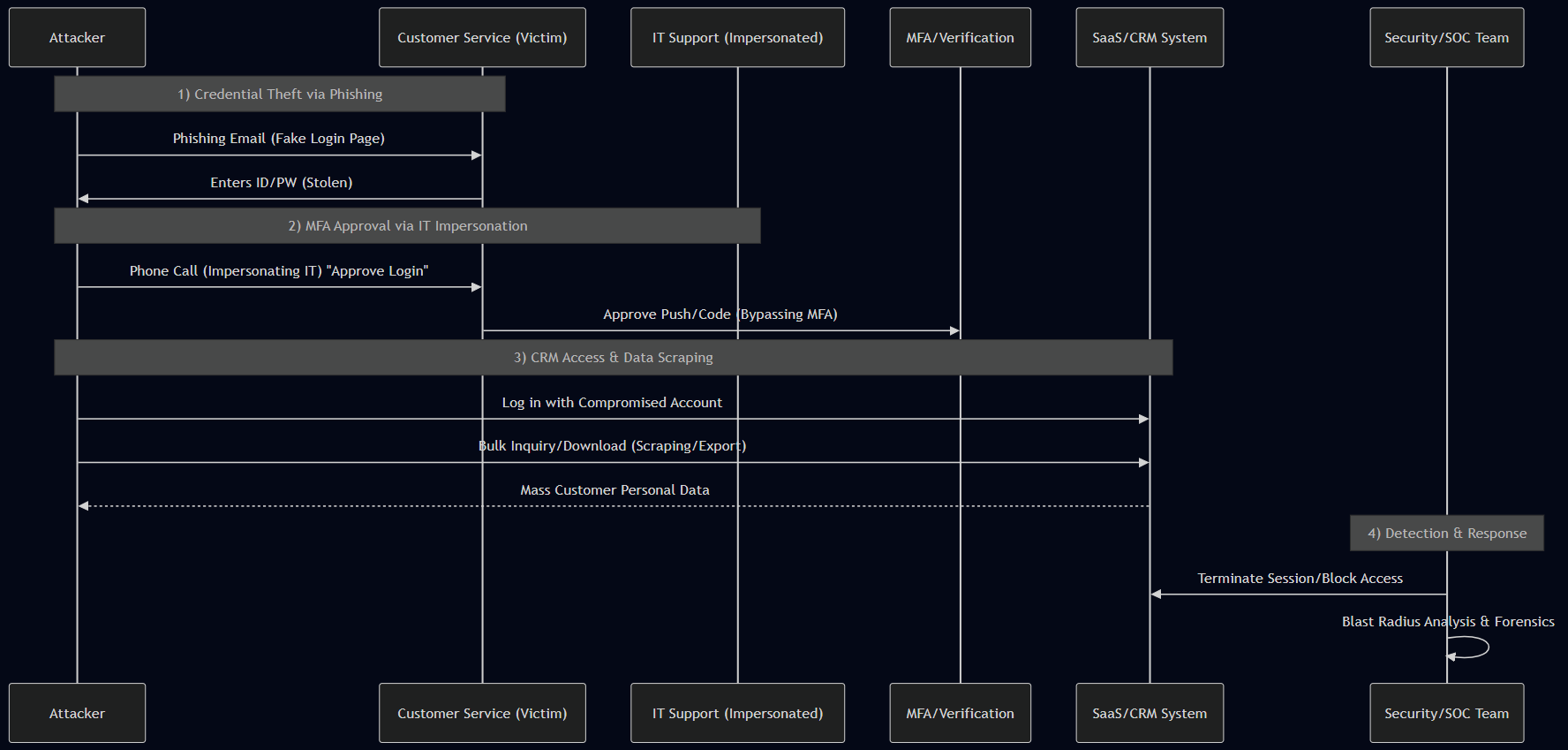
6. Conceptual Diagram of the Exfiltration Method (Scenario)
sequenceDiagram
    participant Attacker as Attacker
    participant CS as Call Center Employee (Victim)
    participant IT as (Impersonated) IT Support
    participant MFA as MFA/Additional Approval
    participant CRM as Customer Contact/CRM System (SaaS/CRM)
    participant SOC as Security/Response Team

    Note over Attacker, CS: 1) Credential theft via phishing
    Attacker->>CS: Phishing email (fake login page)
    CS->>Attacker: ID/PW input (compromised)

    Note over Attacker, IT: 2) Inducing approval via IT support impersonation call
    Attacker->>CS: Phone call (impersonating IT support) "Login approval required"
    CS->>MFA: Push/code approval (additional security step bypassed)

    Note over Attacker, CRM: 3) Access CRM with legitimate account, then scraping/download
    Attacker->>CRM: Login with employee account
    Attacker->>CRM: Mass query/download (scraping/Export)
    CRM-->>Attacker: Customer personal data (large scale)

    Note over SOC: 4) Detection/Response
    SOC->>CRM: Terminate session/block access
    SOC->>SOC: Impact assessment · log forensics
7. Odido’s Publicly Disclosed Response (Summary)
- The company stated that it terminated the unauthorized access, initiated an investigation (with internal and external experts), and notified the relevant authority (AP).
- Customers were advised to be cautious of phishing/scam contacts (smishing and voice phishing).
PLURA Perspective Summary
8. PLURA-EDR Perspective: Audit Policy–Based Anomaly Detection and Verification of Exfiltrated Files
PLURA-EDR enables anomaly detection based on audit policies and verification of downloaded customer data files.
PLURA-EDR provides the following workflow:
- Generate logs through audit policy configuration
- Collect Windows Event Logs / Linux syslog·audit logs
- Analyze collected logs to detect anomalies
- Perform blocking actions according to detection policies
Therefore, the following “evidence-based verification” is possible:
- Trace the activity at the time of large-scale Export/download from a specific account/endpoint through audit logs
- Verify logs showing the creation·movement·compression traces of customer data files (CSV/XLSX/ZIP, etc.) downloaded to endpoints
- Secure those files as part of the incident response investigation and confirm their contents (forensic evidence)
9. PLURA-XDR Perspective: Why “Large-Scale Exfiltration” Is Easily Missed, and How Real-Time Detection Is Possible
Large-scale data exfiltration can be detected in real time through web application firewall data breach detection.
9-1) Why It Is Easily Missed
- Legitimate accounts + legitimate functions (query/Export) can easily be mistaken for routine business operations.
- If downloads occur in the form of web responses (HTTPS), systems that only monitor network traffic may view them as “normal traffic.”
- If login events and download events are separated, risk may be underestimated when evaluating single events.
9-2) Real-Time Detection with PLURA-WAF Data Exfiltration Detection
PLURA-WAF provides:
- Data exfiltration detection based on response body (Resp-body) analysis
- Anomaly detection based on request/response body size (Resp-size)
- Immediate blocking upon detection of exfiltration
In other words, when customer data is delivered in bulk from CRM responses,
the moment when “the download itself is the web response” can be detected and blocked in real time.
References (Sources)
- Odido Official Notice: https://www.odido.nl/veiligheid-eng
- Reuters (2026-02-12): https://www.reuters.com/business/media-telecom/dutch-telecom-odido-hacked-6-million-accounts-affected-2026-02-12/
- Cybernews: https://cybernews.com/security/odido-hackers-phishing-attack/
- CPO Magazine: https://www.cpomagazine.com/cyber-security/cyber-attack-on-dutch-telecom-giant-odido-exposes-customer-data-of-6-2-million/
- SecurityWeek: https://www.securityweek.com/dutch-carrier-odido-discloses-data-breach-impacting-6-million/
- Microsoft Security Blog (DEV-0537 / Strawberry Tempest): https://www.microsoft.com/en-us/security/blog/2022/03/22/dev-0537-criminal-actor-targeting-organizations-for-data-exfiltration-and-destruction/
- CSRB LAPSUS$ Report (2023): https://www.cisa.gov/sites/default/files/2023-08/CSRB_Lapsus%24_508c.pdf
- MITRE ATT&CK (LAPSUS$ Group G1004): https://attack.mitre.org/groups/G1004/
- MITRE ATT&CK (Valid Accounts T1078): https://attack.mitre.org/techniques/T1078/
- NVIDIA Related (Reference): Reuters (2022-03-01) https://www.reuters.com/technology/nvidia-says-employee-company-information-leaked-online-after-cyber-attack-2022-03-01/ / The Verge (2022-03-01) https://www.theverge.com/2022/3/1/22957212/nvidia-confirms-hack-proprietary-information-lapsus
- Samsung Related (Reference): The Verge (2022-03-07) https://www.theverge.com/2022/3/7/22965220/samsung-hack-lapsus-galaxy-source-code-confirmed-nvidia
- PLURA-WAF Overview: https://www.plura.io/en/platform_waf.html