PLURA Is a New Milestone in Cybersecurity in the AI Era
🧭 Conclusion of This Article (3-Line Summary)
- In the LLM era, rapidly emerging products fall into two categories: (1) LLM Wrappers and (2) AI Brokerage/Platforms, but both have structural limitations.
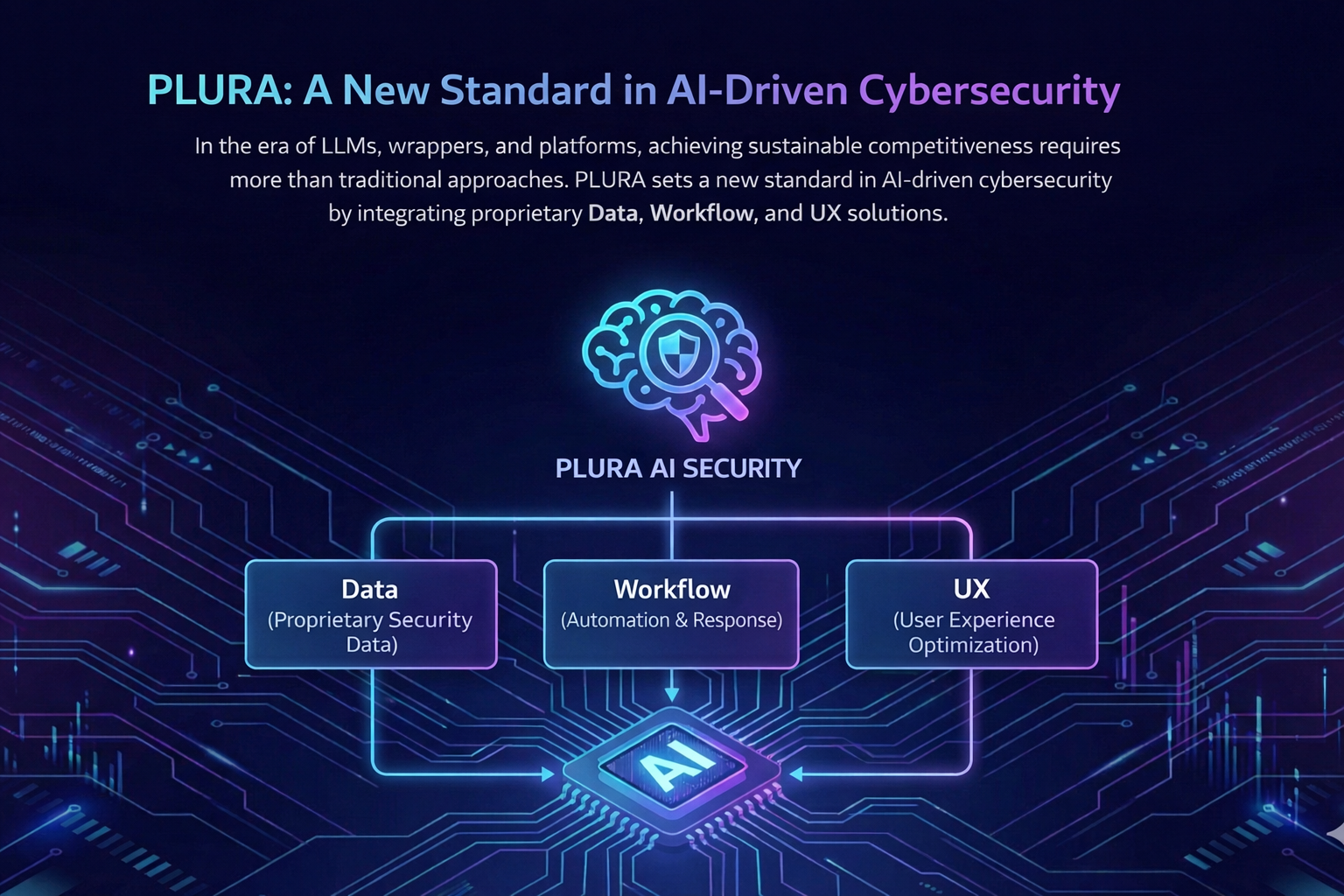
- Ultimately, the companies that survive are those equipped with proprietary data · strong workflows · and exceptional UX as their “weapons.”
- PLURA defines itself as an “information provider,” more precisely a “cybersecurity data company,” and presents a new milestone for security in the AI era.
1) Two Types of Products in the LLM Era — Why Are They Vulnerable in the Long Term?
Recently, generative AI products rapidly increasing in the market can generally be divided into two categories.
1. LLM Wrapper Services: Fast to Attach, But Shallow Moats
LLM wrappers layer UI and features on top of external LLM APIs such as OpenAI and Google to deliver value quickly.
However, structurally they face the following risks:
- Short lifespan of differentiation.
When model providers update their capabilities, the value offered by the wrapper can instantly become a default feature. - Weak foundation for accuracy and trust.
While general-purpose LLMs excel at being “plausible,” high-risk domains such as security demand responses grounded in evidence. - Difficulty accumulating data as a strategic asset.
Even if usage logs accumulate, converting them into security data that improves domain accuracy is not straightforward.
In short, wrappers can easily generate “impressive answers,”
but they struggle to build the power to transform operations (a sustainable weapon).
2. AI Brokerage/Platform Services: Connection Has Value, But Outcomes Are Not Guaranteed
AI brokerage/platform services enable the connection, orchestration, and selection of multiple models.
While useful, this approach also has limitations:
- Brokerage functions can quickly become standardized and commoditized.
If competition shifts toward “who connects more cheaply and conveniently,” defensibility weakens. - Distance from domain-level outcomes.
Connection and orchestration are means; customers ultimately seek business outcomes.
In security, outcomes require a full cycle of Detect → Investigate → Respond → Prevent. - In high-responsibility domains like security, brokerage alone cannot earn trust.
There must be an explainable system clarifying who made the judgment, on what evidence, and why the action is safe.
Platforms can build the “road,”
but who safely guides you to the destination is another matter entirely.
2) The Companies That Survive Accumulate “Weapons,” Not Just APIs
The key question in the LLM competition is this:
“Will the service disappear the moment the model provider releases an update?”
The companies that survive go beyond simply connecting APIs and instead accumulate three strategic weapons:
- Proprietary Data: Achieving accuracy that general models cannot replicate through industry-specific data
- Strong Workflow: Deep integration into real operational processes, not just chat interfaces
- User Experience (UX): Becoming a “daily-use tool” through superior usability
The question is no longer “Did you use AI?”
It is “What operations did AI transform, and on what foundation?”
3) PLURA’s Definition: Not a Product Company, But an Information (Data) Company
PLURA defines itself as an information provider.
In security, “providing information” does not mean simply offering content. It means delivering:
- Evidence (logs/proof) to determine what happened
- Context to understand the situation
- Insights (meaning/prioritization) to decide actions
— all in chronological order.
More precisely, PLURA is a cybersecurity data company.
This definition explains why PLURA becomes stronger in the AI era.
4) Why PLURA Meets All Three Survival Conditions
1. Proprietary Data: In Cybersecurity, Data Is Rare — and Even Harder to Refine
Cybersecurity data does not gain value simply by being abundant.
Value emerges only when data:
- Is normalized (standardized) for comparability
- Is grouped into incident units through correlation analysis
- Is labeled with meaning to ensure reproducibility
This process requires operational experience, not mere collection.
The weapon PLURA builds as a data company lies here.
Security data is not knowledge scraped from the internet — it is facts generated from real operational systems.
2. Strong Workflow: Security Is Complete Only When It Reaches “Response”
The goal of security is not “raising many alerts,”
but reducing damage and preventing recurrence.
Common bottlenecks in traditional security operations include:
- Many alerts but no incident-level grouping
- Slow investigations leading to delayed responses
- Human-dependent responses lacking reproducibility
Therefore, the essence of XDR lies not in detection alone but in operational workflow:
- Detect → Investigate → Respond → Prevent
PLURA designs security around this flow,
and AI is introduced to make it faster and more consistent.
In security, a “good AI” is not one that speaks well,
but one that enables effective response.
3. User Experience (UX): Does It Become a Tool Used Every Day?
Security is harder to operate than to deploy.
UX is not about looking beautiful — it must answer:
- Is this alert a real threat?
- What is the scope of impact? (account/host/network/time)
- What should be done first to reduce damage?
- How quickly can reporting and sharing be completed?
PLURA’s UX is not a simple dashboard,
but a decision-support interface that shortens operational time.
5) PLURA’s AI: Not Wrapping LLMs, But Intelligence Built on Security Data
The key distinction is clear:
- LLM wrappers place AI on top of the product
- PLURA places AI on top of data and workflow
Thus, PLURA’s AI is not designed to “converse well,”
but to accelerate security operations.
For example, LLM can:
✅ 1) Convert Alerts into Human-Readable Incident Summaries
- Incident overview (what happened)
- Timeline (when and how it progressed)
- Related events (why they are connected)
- Priority (why immediate action is required)
✅ 2) Accelerate Natural Language–Based Threat Hunting
Security professionals often begin with intent rather than queries:
- “Any abnormal login attempts from admin accounts recently?”
- “Which hosts communicated externally after suspicious PowerShell activity?”
LLM translates intent into searchable form, accelerating hunting speed.
✅ 3) Automate Reporting and Communication
Security teams are busy not only with response, but also with explanation and communication:
- Executive summaries
- Technical details (IOC/timeline/actions)
- Audit/compliance documentation
LLM accelerates documentation, enabling teams to focus on response rather than writing.
Crucially, all of this earns trust only when it operates on security data as evidence.
6) Conclusion: PLURA Redefines AI-Era Security Competition Through Data
Products in the LLM era emerge quickly and change rapidly.
But one truth remains constant:
Cybersecurity builds trust only on facts (logs) and evidence.
Therefore, PLURA is not a tool company, but an information (data) company.
By layering workflow, UX, and LLM on top of that data,
PLURA presents a new milestone for cybersecurity in the AI era.
- Build accuracy through proprietary data
- Transform operations through workflow
- Create daily-use systems through UX
- Increase speed and consistency through AI
This is the direction of “reliable AI cybersecurity” that PLURA proposes.
📰 Related Article
- “Stop the AI Shell Game”… Google VP Warns of Two Unsustainable Business Models: https://zdnet.co.kr/view/?no=20260223094534